
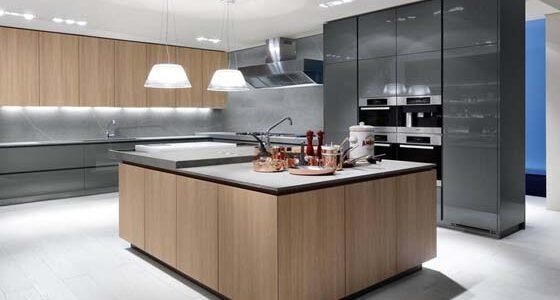
How Much Does a Modular Kitchen Cost in Lucknow in 2027?
Planning a new kitchen is thrilling but a common question among most homeowners is: A modular kitchen costs how much in Lucknow?
Your kitchen cost will be determined but not limited to the kitchen’s width. The final price will be influenced by your chosen layout, cabinet material, shutter finish, countertop, hardware and storage accessories.
These days in 2027, the price of a modular kitchen varies according to different budgets in Lucknow, among which you have simple and broad-modular kitchens to premium ones with the glint of contemporary finishes and high technology storage solutions.
However, basing your kitchen selection only on the price is not ideal. All the same, the type of material you prefer can be just as hard to decide as the tables for your soaps, your cooking techniques and daily use.
In this guide, we will clarify modular kitchen prices in Lucknow, discuss which layouts and materials are good options and what you should know before you set your kitchen budget.
Quick Answer: What Is the Modular Kitchen Cost in Lucknow in 2027?
The cost of a modular kitchen is determined by its features and the amount of cabinetry you need. Listed below are indicative ranges for the 2027 planning benchmark in a Tier-2 city such as Lucknow, which could generate an initial budget for homeowners to consider.
| Kitchen category | Estimated price per running foot |
|---|---|
| Basic modular kitchen | ₹5,300–₹7,900 |
| Mid-range modular kitchen | ₹7,900–₹12,300 |
| Premium modular kitchen | ₹12,300–₹19,350 |
Indicative planning estimates, not hard market rates or a manufacturer’s quotation These prices are indicative of the cost of the project and are not fixed market rates or a quotation from a particular dealer The final price however is based on the design, material specifications, hardware, installation, and inclusions detailed in the quotation. The total cost to build a kitchen depends on many variables, each affecting the overall price.
1. Modular Kitchen Cost Based on Kitchen Layout
The kitchen layout is one of the first things that affects your budget. Different layouts require different amounts of cabinetry, countertops and accessories.
Here are some popular modular kitchen configurations and their approximate planning costs.
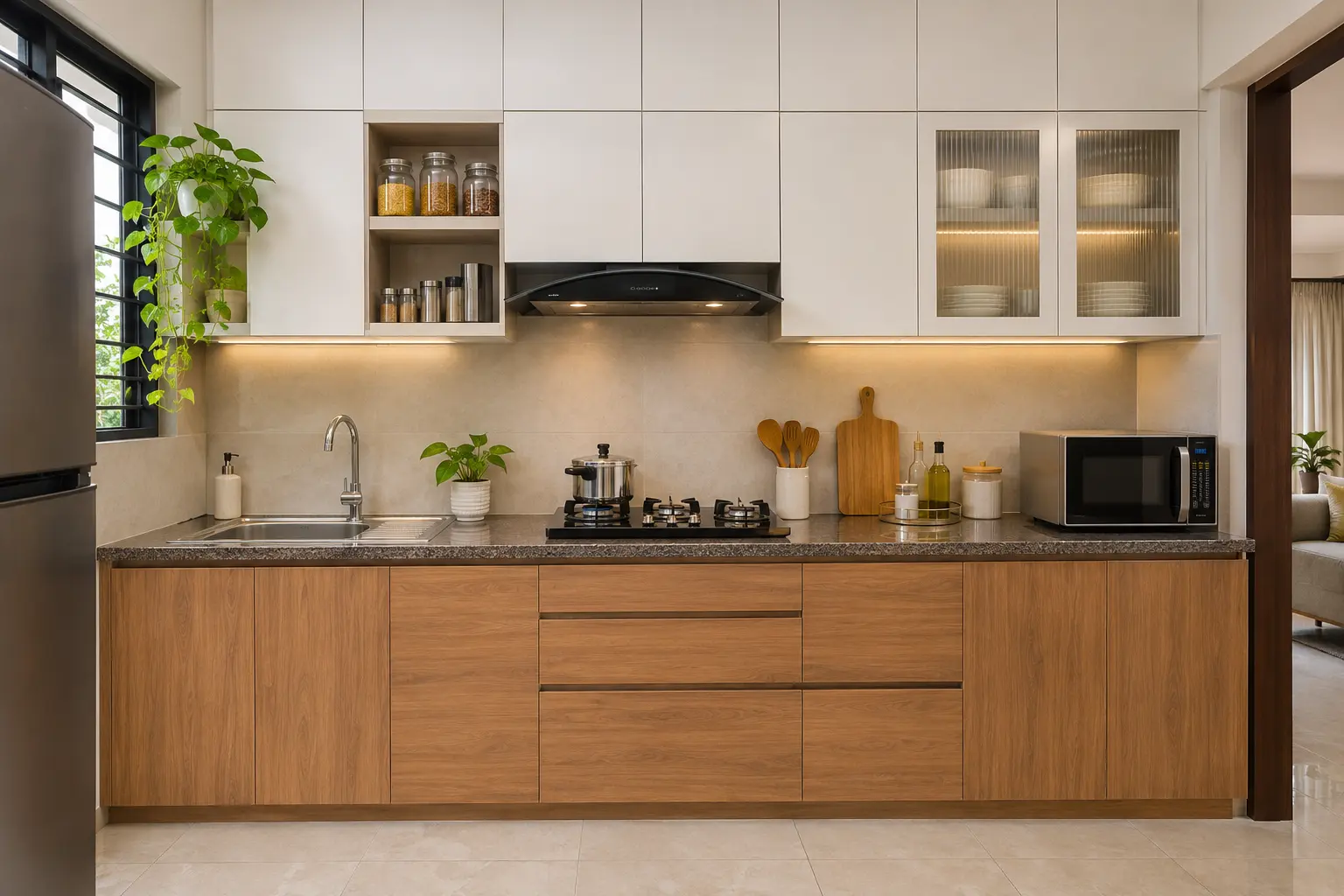
Straight Modular Kitchen
A straight kitchen is designed along a single wall. It is a practical option for compact apartments and homes where space is limited.
Estimated budget:- Basic: ₹53,000–₹79,000
- Mid-range: ₹79,000–₹1.23 lakh
- Premium: ₹1.23–₹1.94 lakh
Example: 10 running feet of cabinetry.
It is suitable for homeowners who want a simple kitchen with essential storage without using too much floor space.
L-Shaped Modular Kitchen
An L-shaped kitchen uses two adjoining walls and creates a convenient working area. It is popular in Indian homes because it offers a practical balance between storage and movement.
Estimated budget:- Basic: ₹74,000–₹1.11 lakh
- Mid-range: ₹1.11–₹1.72 lakh
- Premium: ₹1.72–₹2.71 lakh
Example: 14 running feet of cabinetry.
This layout can work well in medium-sized kitchens where homeowners need additional counter space and organised storage.
Parallel Modular Kitchen
A parallel kitchen has two opposite countertops. One side can be used for cooking and the other for preparation, washing or additional storage.
Estimated budget:- Basic: ₹84,800–₹1.26 lakh
- Mid-range: ₹1.26–₹1.97 lakh
- Premium: ₹1.97–₹3.10 lakh
Example: 16 running feet of cabinetry.
It is particularly useful when the kitchen has enough width to allow comfortable movement between the two counters.
U-Shaped Modular Kitchen
A U-shaped kitchen uses three connected sides to create a generous working and storage area.
Estimated budget:- Basic: ₹1.06–₹1.58 lakh
- Mid-range: ₹1.58–₹2.46 lakh
- Premium: ₹2.46–₹3.87 lakh
Example: 20 running feet of cabinetry.
This layout is suitable for larger kitchens where homeowners want more countertop space, drawers and organised storage.
Important pricing note: Calculated the recommendations above using indicative per-running-foot rates. These figures include base and wall cabinetry and associated countertop allowance in the underlying benchmark, not complete turnkey kitchen prices. Appliances, plumbing, electrical work, civil changes and other extras may be summed into additional costs. GST and Installation inclusions should be confirmed in the final quotation.
2. How Kitchen Materials Affect the Overall Price
The material used for kitchen cabinets is an important factor when planning your budget.
Kitchens look the same from the outside but they work very differently inside, with a huge reliance on the materials used within the cabinet space to determine its level of durability and maintenance requirements.
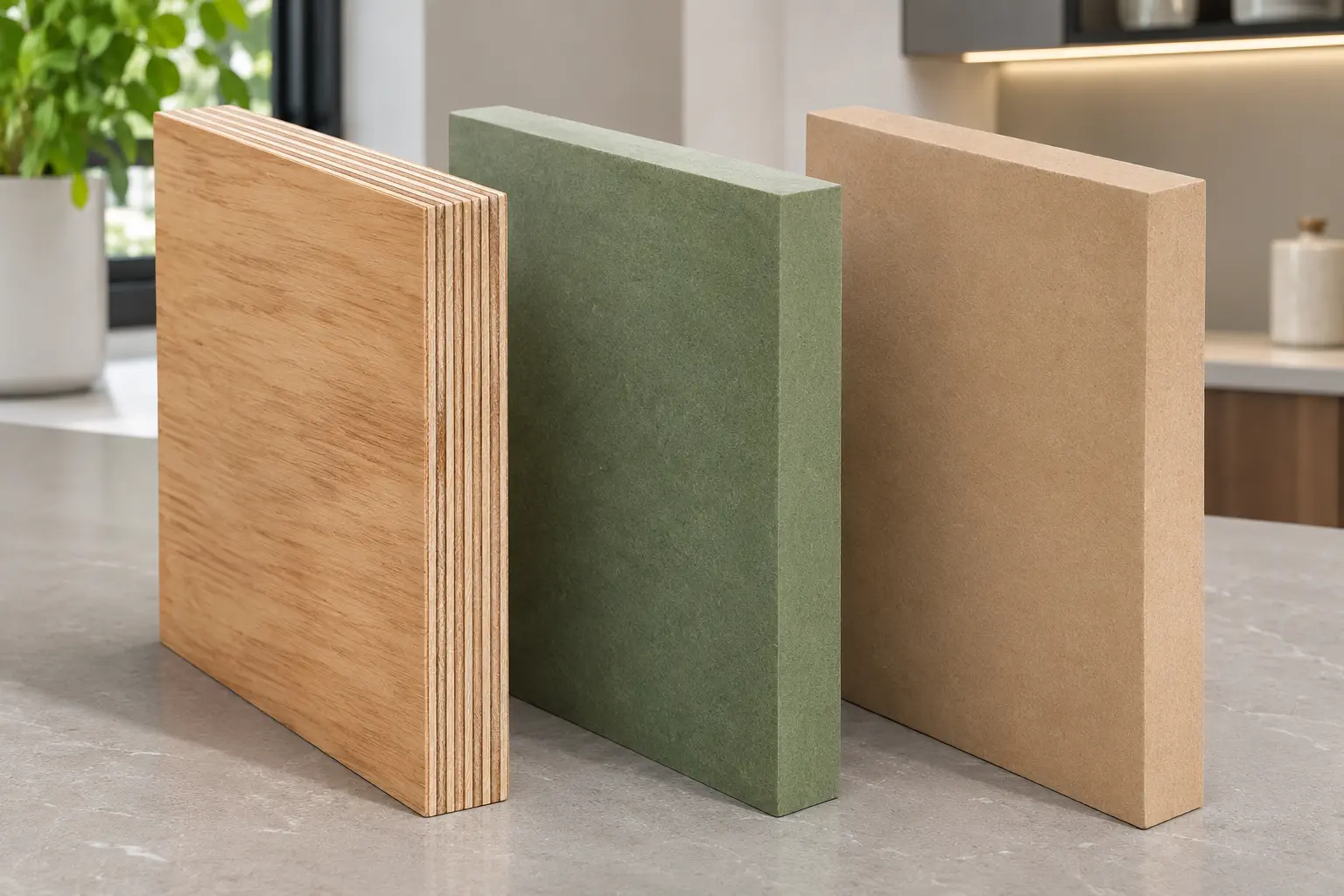
Plywood
Plywood is made by layering veneer onto a core. Given its structural integrity, it is commonly used for kitchen cabinetry.
Although whichever grade you choose is important, when selecting plywood for a kitchen (especially in high-moisture zones), BWR and BWP should also be considered.
Why consider plywood?- Good structural strength
- Suitable for different cabinet designs
- Available in different grades
- Can support a variety of shutter finishes
The appropriate grade should be selected according to the cabinet’s location and exposure to water.
HDHMR
HDHMR stands for High-Density High Moisture Resistant board. It is an engineered wood product used in furniture and cabinetry.
Why consider HDHMR?- Smooth surface for finishing
- Suitable for many contemporary cabinet designs
- Consistent board construction
- Available in different thicknesses
Its performance depends on the board quality, edge sealing and installation. It should not automatically be considered waterproof.
MDF
MDF, or Medium Density Fibreboard, is an engineered wood product made from wood fibres.
It is commonly used for furniture panels and decorative applications.
Why consider MDF?- Smooth surface
- Suitable for painted and decorative finishes
- Uniform construction
- Useful for selected cabinet and shutter applications
Standard MDF is generally less suitable for areas with repeated moisture exposure unless the appropriate moisture-resistant grade and protective treatment are used.
Which material should you choose?
There is no single material that is best for every kitchen. Consider your budget, cabinet location, moisture exposure, expected usage and the manufacturer’s specifications before making a decision.
3. Modular Kitchen Shutter Finishes and Their Cost Impact
The shutter finish is the visible surface of your kitchen cabinets. It has a significant influence on the overall appearance and price.
Here are some popular choices.
Laminate Finish
Laminate is a practical choice for homeowners who want a wide range of colours and patterns.
Advantages:- Available in matte and glossy options
- Multiple colour and texture choices
- Generally easy to maintain
- Available across different price segments
It is a suitable option for homeowners looking for a balance between appearance and budget.
Acrylic Finish
Acrylic finishes are known for their smooth, reflective and glossy appearance.
Advantages:- Premium visual appeal
- Reflective surface
- Contemporary appearance
- Available in different colours
Acrylic can be a good option for homeowners who prefer a modern, high-gloss kitchen.
Membrane Finish
Membrane shutters use a decorative PVC film applied over a shaped board.
Advantages:- Seamless-looking surfaces
- Suitable for selected decorative profiles
- Different colours and designs
- Options for contemporary and traditional kitchens
The quality of the board, membrane and application process should be checked before choosing this finish.
PU Finish
Polyurethane, commonly called PU, is a premium coating used for a smooth painted appearance.
Advantages:- Refined finish
- Wide range of colours
- Options for matte and glossy surfaces
- Suitable for modern kitchen designs
The cost depends on the coating quality, preparation, design and application.
When comparing finishes, do not focus only on their appearance. Ask about scratch resistance, cleaning requirements, repair options and warranty coverage.
4. Other Important Factors That Influence Modular Kitchen Pricing
Other than what they are made of and the sharpness of their edges, there are many smaller elements that can create a huge difference in the costs.
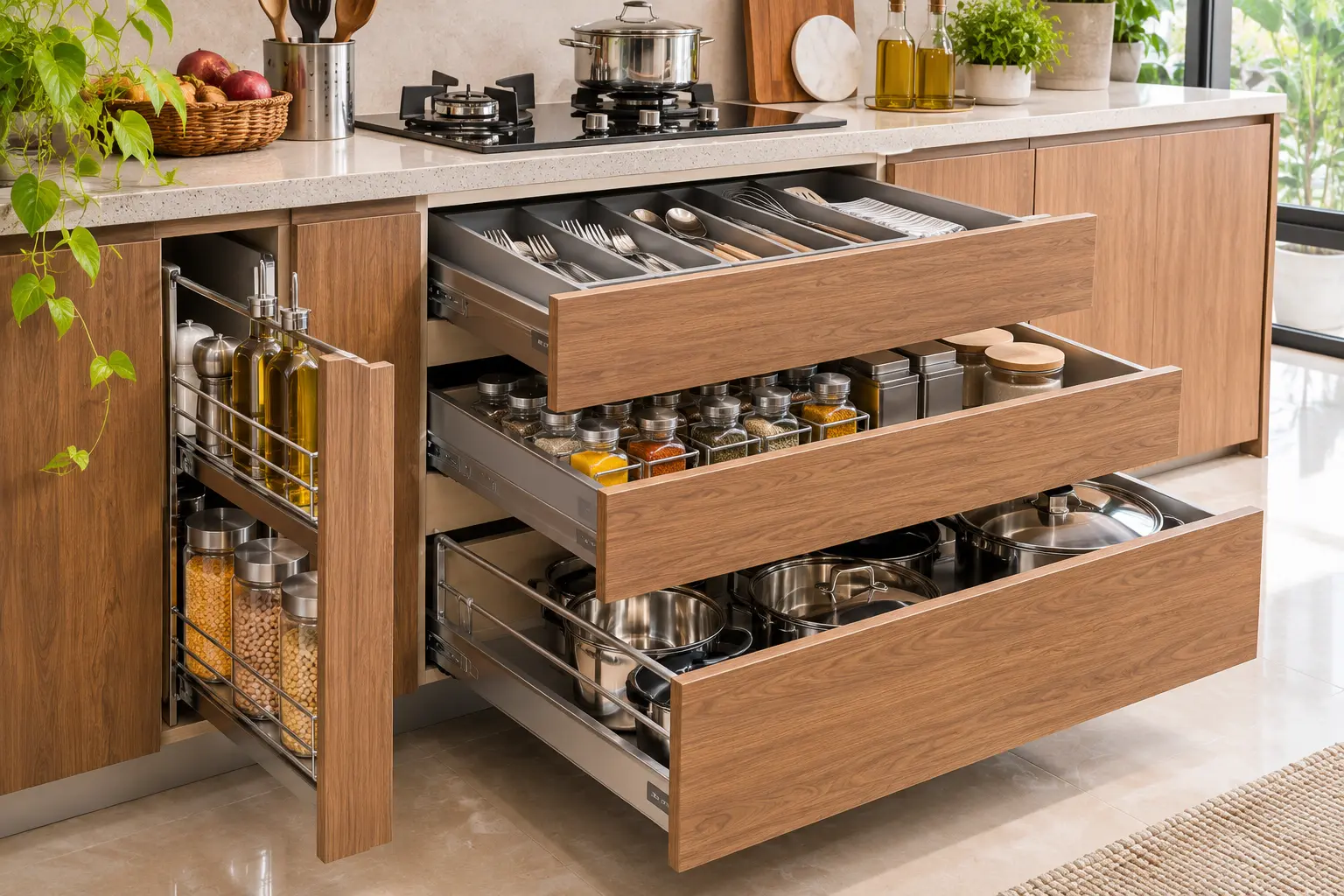
Kitchen Hardware and Fittings
Hinges, drawer channels, handles and lift-up mechanisms influence the convenience and performance of kitchen cabinets.
Some common options include:
- Soft-close hinges
- Drawer channels
- Tandem drawers
- Corner storage mechanisms
- Lift-up cabinet fittings
- Pull-out baskets
Branded hardware may cost more initially, but smooth operation and reliable performance are important considerations for frequently used cabinets.
Kitchen Countertop
The countertop is one of the most frequently used parts of a kitchen.
Popular choices include:
- Granite
- Quartz
- Other engineered stone surfaces
The cost depends on the material, thickness, colour, edge profile and installation requirements.
Kitchen Accessories
Accessories help make kitchen storage more organised and convenient.
Some commonly used options include:
- Cutlery organisers
- Bottle pull-outs
- Tall pantry units
- Corner units
- Plate racks
- Under-sink organisers
- Spice pull-outs
Not every accessory you find on the market is necessary for you. Pick them depending on your cooking and storage habits.
Sink and Faucet
The sink and faucet must be selected according to available countertop space, plumbing configuration, and daily usage. This means that the overall project cost will be influenced by factors such as the size of the sink, the grade of the faucet, or specialized installation.
Chimney and Hob
Kitchen appliances are often quoted separately from modular cabinets.
So, when it comes to designing your kitchen, be sure to weigh in what appliances you actually need (the chimney, hob, built-in oven, etc).
If dimensions are known prior to cabinet manufacturing, they can be checked and it will be a lot easier to package everything together properly.
5. Additional Expenses to Consider Before Finalising Your Budget
One common mistake homeowners make is comparing only the cabinet price.
A modular kitchen project may include additional work that is not part of the initial estimate.
Here are some expenses worth discussing with your dealer:
| Additional requirement | Why it matters |
|---|---|
| Plumbing modifications | May be required when changing sink positions |
| Electrical work | Needed for appliances and additional sockets |
| Civil modifications | May include wall, flooring or platform changes |
| Backsplash | Adds protection and improves appearance |
| Chimney installation | May involve ducting and exhaust work |
| Transportation | Depends on delivery distance and project terms |
| Installation | Confirm whether labour is included |
| GST | Check whether the quoted price includes applicable taxes |
Always ask for a written quotation that clearly explains what is included and what will be charged separately.
This makes it easier to compare different proposals without being surprised by additional expenses later.
6. How to Plan a Modular Kitchen on a Budget
A beautiful kitchen does not necessarily require spending on every premium feature.
The goal should be to invest in the components that matter most for everyday use.
Here are some practical ways to manage your budget.
1. Choose the right layout
Select a layout based on your available space rather than choosing a complicated design simply because it looks attractive.
2. Prioritise cabinet quality
Give attention to the cabinet material, edge protection and areas exposed to moisture.
3. Select practical finishes
If you would like to have a great look but don’t want to splurge on an expensive premium finish, laminate can serve as a practical alternative.
4. Avoid unnecessary accessories
Choose storage accessories based on the items you actually use. You want additional functionality only when it addresses a real need for storage.
5. Plan appliances in advance
Deciding the position and size of appliances before manufacturing can help avoid last-minute modifications.
6. Compare detailed quotations
Ask different dealers to specify the same cabinet material, finish, hardware and countertop before comparing prices.
7. Keep some budget for unexpected work
A small provision for plumbing, electrical or installation-related changes can make the project easier to manage.
7. How to Choose the Right Modular Kitchen for Your Lucknow Home
Lucknow homes have different kitchen sizes, layouts and requirements. A design suitable for a large independent house may not work in a compact apartment.
Before selecting a kitchen, consider the following:
- Available space: Measure the kitchen area accurately.
- Cooking habits: Think about how many people regularly use the kitchen.
- Storage requirements: Consider utensils, groceries, appliances and daily essentials.
- Ventilation: Plan the chimney and ventilation arrangements.
- Cleaning: Choose surfaces that are practical to maintain.
- Future needs: Consider whether your storage requirements may change over time.
A well-planned kitchen should make daily cooking more convenient rather than simply looking attractive in photographs.
8. Why Consider Naresh Traders for Your Modular Kitchen in Lucknow?
It is a long-term decision to choose a modular kitchen. An important factor is you working together with a showroom that will help you understand the different options in regard to designs, materials, and products as to make an informed purchase decision.
Naresh Traders, established in 1970, is Lucknow based modular kitchen and home interiors solutions provider.
Customers are guided in the process of planning their kitchen requirements by the team.
This process includes:
- Understanding the customer’s requirements
- Site visits and measurements
- Preparing detailed drawings and 3D layouts
- Discussing quotations and budget options
- Rechecking the site against final drawings
- Order processing and installation
- Final delivery
Easiest steps to make your kitchen designs based on the space you have and preferences and budget you want to work in with home owners. Whether you are moving forward with a brand new kitchen project or making changes to an existing space, Naresh Traders are options you can find.
Explore: Modular Kitchen Dealer in Lucknow
Visit the showroom: No. 1, Shubhansh Complex, Faizabad Road, Indira Nagar, near Shakti Nagar Dhal, Lucknow, Uttar Pradesh 226018.
Call: +91 9956475058
Final Thoughts
It isn’t only about selecting fancy cabinets when planning a modular kitchen. It’s about devising a practical space that works best for you, your cooking style, and your budget. Layout, material of the cabinet, shutters upholstery, hardware and overhead in addition to extra installation costs, it best to always compare. You could benefit from a nearing modern modular kitchen quotation to really see what you are paying for. If you plan a modular kitchen in Lucknow, be patient and explore the various options, and choose the design that balances functionality, durability and looks best for you. Ready to plan a kitchen? Contact Naresh Traders to talk about what you need, review the designs on offer, and learn about the options you can afford.
Frequently Asked Questions About Modular Kitchen Cost in Lucknow
1. What is the average modular kitchen cost in Lucknow in 2027?
The cost would be based on the custom size, lay out of the kitchen, type of cabinet, finish, and hardware. At a very high-level, a baseline may start with basic kitchens from ₹5,300 per running foot while premium specs would cost significantly more. A site-specific quotation is required to provide an accurate estimate.
2. What is the price of a 10-foot modular kitchen in Lucknow?
Using indicative 2027 planning rates, a 10-running-foot kitchen may cost approximately ₹53,000–₹79,000 for basic specifications, ₹79,000–₹1.23 lakh for mid-range specifications and ₹1.23–₹1.94 lakh for premium specifications. Confirm the exact inclusions before comparing quotations.
3. Which modular kitchen layout is more affordable?
Straight modular kitchens are said to be more affordable, as they usually involve fewer cabinets and countertops. However, the actual cost will vary on the design and specification.
4. Is plywood better than MDF for a modular kitchen?
Plywood, especially the BWR or BWP grades of it, tends to be a more suitable option for kitchen cabinet carcasses in damp areas. Depending on its grade and protective treatment, MDF can work for some applications.
5. Which modular kitchen finish is best for everyday use?
Laminate is practical with many households because of its different options and easier maintenance. Popular choices among those buyers wanting a more high-end look include acrylic and PU.
6. Does a modular kitchen price include chimney and hob?
Not necessarily. Chimney, hob and other appliances are often charged separately. Always confirm whether appliances, installation and ducting are included in your quotation.
7. How can I reduce the cost of a modular kitchen?
Adjust costs by planning an economical layout, using proper materials, avoiding needless add-ons and comparing the comprehensive quotes. It is important for you not to cut corners by sacrificing the quality of the cabinet just to diminish the front end cost.
8. How long does it take to install a modular kitchen?
The schedule depends on design finalisation, material availability, finishing work, site readiness and the complexity of installation. Therefore you should request a project-specific timetable from the dealer, as opposed to a generic production estimate statement.
9. Can I customize a modular kitchen according to my budget?
Yes. Cabinet configurations, materials, shutter finishes and storage accessories can be chosen to fit with your wants and with your house’s budget. A fact-finding approach and site measurements could pinpoint the configuration that fits best.